NOT TO BE TAKEN LIGHTLY


We stepped—or perhaps even stumbled—into 2025 a little more than a week ago, and at least this much is true: For the most part, the world’s billionaires are doing quite well, with this being particularly true for the ones hailing from the United States. A recent Bloomberg Billionaires Index, for instance, shows that of the fifteen wealthiest individuals in the world, almost all of them—14— claim the United States as their home.
For one thing, the size of the U.S. billionaires club increased by 84 individuals, climbing from 751 in 2023 to 835 in 2024 (see chart below).
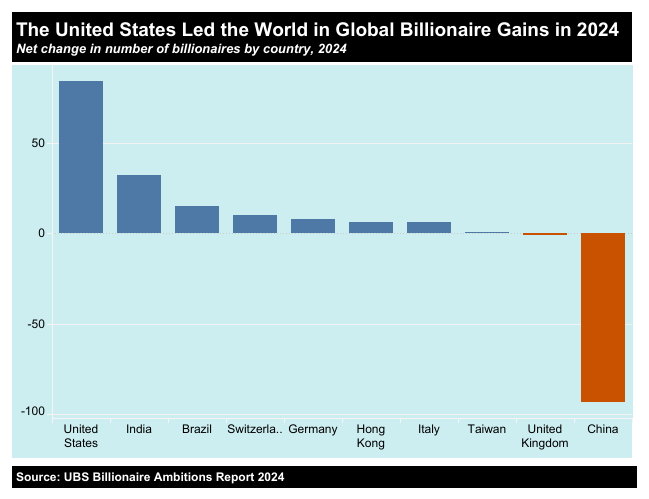
This number swamps those of the other listed countries and stands in sharp contrast to the loss of 93 members in China’s billionaire club
In absolute numbers that swamps the recorded increase for the other listed companies and, furthermore, stands in sharp contrast to the net decrease of 93 million holding membership in China’s billion dollar club.
And, not surprisingly, it’s Elon Musk who tops the list of the world’s richest people, with a net worth recently estimated at $416 billion. Coming in second—and he’s not even close to Musk— is Amazon’s Jeff Bezos at $236 billion.
According to Forbes’ Real Time Billionaires List, the net worth of just the top ten richest billionaires clocks in at an astounding $1.9 trillion, up from the $1.8 trillion recorded at the end of 2024.
What’s more, wealth is heavily concentrated in the hands of a few and, again, this is a particularly true for the United States.
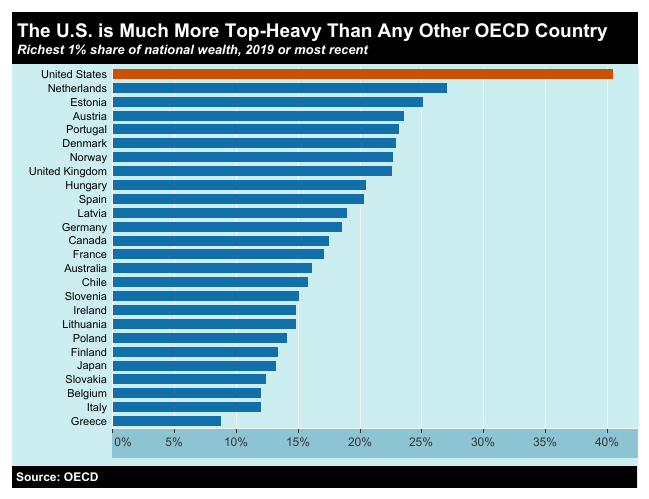
For example, data compiled by the Organization for Economic Co-operation and Development (OECD) documents that the richest one percent in the U.S. own an astoundingly high 41% of all wealth. This concentration of wealth far exceeds that of any other OECD country.
So, however you cut it, the supe- rich in the United States are big time wealthy, few in number, and control a disproportionately high percentage of the nation’s collective net worth.
And when it comes to politics, the wealthy have enormous power to influence political candidates and to shape the political and economic policies pursued by those who win electoral contests.
Multimillionaires—and their billionaire “cousins”— are much more likely than the general public to favor political and economic policies that eventuate in lower taxes, less government spending, an obsession with reducing the federal debt, less regulation of, and intervention in the “free” market, and a whole sale slashing — if not outright elimination of— Social Security, income support programs, and Medicaid. Compared to the general public, the super-rich also reek of antiunionism.
The political preferences of this tiny and extrardinarily wealthy group is a threat to the common good. Their power to shape and direct the trajectory of the nation’s political economy down a path that would increase the suffering of millions is not something to be taken lightly.